TNR BLOGS

August 29, 2008 | 4:54 PM
August 29, 2008 | 4:44 PM
August 29, 2008 | 4:42 PM

August 27, 2008 | 11:42 PM
August 27, 2008 | 6:45 PM
August 27, 2008 | 6:43 PM

July 26, 2008 | 2:24 PM
July 23, 2008 | 1:55 PM
July 17, 2008 | 3:56 PM

August 29, 2008 | 6:47 PM
August 29, 2008 | 4:44 PM
August 28, 2008 | 6:37 PM
COLUMNISTS
TODAY'S STORIES
26.06.2008
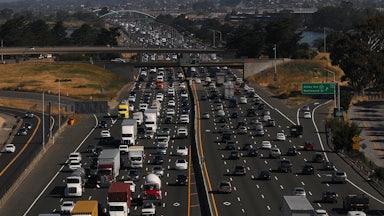
"The Greatest Mass Exodus of Vehicles" in U.S. History?

Via the WSJ's Keith Johnson, this new oil forecast from Jeff Rubin of CIBC World Markets is genuinely shocking, especially with its prediction of $7/gallon gas in the United States by 2010. There seems to be no way to avoid it: Saudi Arabia's pledge to pump out more crude amounts to a "pittance," China's decision to cut gas subsidies will barely move prices, and the most promising attempts to open up new supplies, in both the Canadian oil sands and Gulf of Mexico, have been plagued by overruns and delays. So, add it all up, and the effects on driving in the United States are going to be titanic:

Over the next four years, we are likely to witness the greatest mass exodus of vehicles off America’s highways in history. By 2012, there should be some 10 million fewer vehicles on American roadways than there are today—a decline that dwarfs all previous adjustments including those during the two OPEC oil shocks. ...

Our analysis suggests that about half of the number of cars coming off the road in the next four years will be from low income households who have access to public transit. At their current driving habits, filling up the tank will have risen from about 7% of their income to 20%, an increase that will see many start taking the bus.

If a nightmare scenario like this comes true, it'd be hard to overstate how monstrous a change this would be. Nearly 57 million car-owning households have "reasonable" access to some form of public transit, so that's where most of the shift will happen, but even then, it won't be easy—especially since transit systems are already overwhelmed (and facing budget shortfalls themselves because of high oil prices). And people in more remote—and especially rural—areas will be screwed.

Eventually, land-use patterns would start to change. Already people are starting to move out of the suburbs and closer to city centers in response to high gas prices, but it's another thing entirely for millions to abandon the vast car-oriented infrastructure we've erected over decades and try to adopt European-type living patterns in just a few short years. To put things in perspective, only about 5 percent of Americans used public transit to commute as of 2005, compared with about 50 percent in Japan and Europe, where pricey gas has long been a reality. It's not clear whether the United States could scale up that quickly by, say, 2012, though it sounds like, among other things, it would be a good idea to get started now. (Oh, and that's not even touching on the potential for stagflation if $7/gallon gas really is on the way.)

--Bradford Plumer

Posted: Thursday, June 26, 2008 5:33 PM with 49 comment(s)

Comments

You must be logged-in to comment.

Not a subscriber? Click here to get a digital or print and digital subscription to The New Republic!

williamyard said:

Another factor: the superior aesthetics of commuting by mass transit.

Four months ago when I moved about 30 miles farther from my job south of San Francisco, I dreaded the longer commute. What had been a half-hour would balloon to an hour and a half, or sometimes longer. Instead, the longer commute is now one of the best parts about living farther away.

The reason is that I now take the train (BART) and a company shuttle instead of driving. Suddenly I've added a couple hours of "me" time, five days a week: no job, no girlfriend, no litter boxes to empty, no road rage to cork. Just me an' my trusty iPod and a novel or the New Yorker or maybe a report for work that needs redlining. Or I nap, or gaze at the little pink houses and ponder the meaning of existence. I now get to work refreshed, and get home nicely chilled.

Oh, and I save a fortune on gas, bridge tolls, auto maintenance, insurance, and depreciation. That's something, I suppose.

Americans have long held that solitary confinement within one's internal-combustion exoskeleton is the superior way to travel. To those Americans I say, take a bus or train. Look out the window and discover a rib joint not far from your house, read something besides the cartoons and "Talk of the Town." Dig the swoosh of the tires through rain, the preschoolers at the bus stop holding hands on the way to a field trip, the old Russian ladies gesticulating in studied solemnity, the glorious family of humankind of which you are a part.

June 26, 2008 1:34 PM

singlespeed said:

Yard...if you can make taking the bus sound that poet perhaps there's hope out there after all. As someone who's commute time by bike is 9 miles one way, I've discovered that I can match the metro commute time. I get a chance for some exercise, get fresh air, chuckle at all the SOVs stuck in traffic along the Memorial Parkway trying to cross into DC and in the evenings I get to oogle at all the urban wildlife as they jog, ride their bikes, or push the strollers.

Needless to say, I haven't experienced a case of vehicle-induced road rage in 2+ years. Of course, when the weather turns south I can jostle for metro handrail space next to said wildlife in their skirts and heels while pretending to read some heavy literary tome.

June 26, 2008 1:50 PM

jwl2672 said:

williamyard, I'm happy you're enjoying your commute.  The reality is that it is not as much lollipops and sunshine as you make it out to be.  

Imagine cramming onerself into an overcrowded subway, right next to the fellow with the horrifyingly, organic stank.  You being short, your head is right underneath the hairy underarm of a sweaty and fat construction worker headed home for the day.  As you ponder the beauties of nature that you see right outside your subway window (i.e. rats and mold), a man behind you jostles you and not accidentally, places his hands firmly on your buttocks.  When you turn to confront the person, not knowing whether or not to make eye-contact, the subway jerks violently to the left, sending you flying into the lap of a pregnant woman who gives you a dirty look.  Uttering hasty apologies, you return your attention to your 5-foot wide newspaper, which crumples and shifts, making it utterly impossible to read anything but the headlines.  You finally reach your stop, after 45 minutes of delays and 2 sick passengers.  Walking into your building, you realize that it's only Monday...

June 26, 2008 2:05 PM

williamyard said:

Yeah, s.s., there's also that wildlife angle.

It's criminal what an occasional moment or two of serendipitous eye contact on BART does to this old lecher's self-esteem.

June 26, 2008 2:05 PM

dylanposer said:

Yard, you must have it so nice easing back on those plush, wide seats of a dependable stop-and-go bullet train.  Have you ever had to take the N-Judah anywhere between the hours of six in the morning and eleven at night?  I don't know if they have a migrane immunization for the experience, but I'm always on the search for one.  

June 26, 2008 2:17 PM

williamyard said:

jwl,

Granted, mass transit can be a drag. There is no perfect transit system, and I've ridden some that are worse than others.

In my experience a lot depends on who's doing the riding and how the community in which the transit operates regards the system's status. Even the same bus line can offer extremes: one streetcar in San Francisco that I rode regularly for years was terrific except when it passed by a notorious high school at the end of the school day, when a zillion punks entered and insisted on acting out their loserhood. No mass transit system exists in a vacuum. But, you know, when the pregnant woman gets on and I get up to give her my seat, and a young man under peer pressure from the punks, on the cusp between being a jerk and being a decent young man, takes notice, maybe--just maybe--he pays attention. Maybe he thinks. Maybe he learns something.

One of the implications of mass transit is that, as a community service, it requires communication and compromise, two traits that members of many communities don't have to practice too often. Now, I happen to feel that the ability of members of a community to communicate and compromise with each other--even grudgingly--is better ultimately than continually segregating them from one another, in that such segragation breeds ignorance, fear, and intolerance. The internet is one method for exposing ourselves to others, but so is a ride on the 33 Stockton through Chinatown.

Sometimes, as Jackson Browne sang, "the damage will do you good."

June 26, 2008 2:30 PM

williamyard said:

dylan,

I live in Concord now but lived in the City from '71 to '08; about half that time I spent on Muni and BART. I'm on BART (Concord to Glen Park) and the company shuttle (G.P. to S.S.F.) now. I'm particularly familiar with the J, the 44, the M to and from S.F. State, the 38 Geary (daily for 4 years), the 24, the Van Ness lines (47), the Mission lines. The 14 Mission has to be one of the ultimate urban tour buses on the planet. I've taken the N often but usually just from Carl Street into Upper Market, not so much out into the Sunset, and never as a work commute route.

Granted, BART is a step up. A little money into Muni, though, would go a long way, IMHO. Also, the more that wealthier people ride it, the better it will get.

I've always disliked the nighttime bus routes primarily because of their infrequency and of the problems thus accruing from my bladder full of recycled beer.

So it's kind of a chicken-and-egg thing: will mass transit improve and thus riders' opinions of it, or will riders first warm to the idea and thereafter the seats will tend to stick to one's thighs less frequently?

June 26, 2008 2:46 PM

jwl2672 said:

I agree with you - as in almost all things, the quality is dependent on the character of the people.  If no one vandalized the NYC subway system, perhaps the money could be better spent on improvements.

However, the MTA here in NY has been the most dysfunctional quasi-public/private institution on Earth.  Their incompentence is laughable were it not sad.  I doubt they'll be able to handle the migration from cars to public transit.  As you said, it's circular.  Without improvements on the system, the migration will not happen.  And if the migration does not happen, the MTA will not improve its system.

I personally walk the 30 blocks to work.  It's great exercise, I save $4/day, and I don't have to be groped in the butt.

June 26, 2008 2:53 PM

singlespeed said:

JWL...are thy cursing your beloved MTA? Having had the pleasure and misfortune of riding that subway system at various times of the day, I'd say I'd agree with your assessment of MTA. The idea of a clean subway stop is antithetical to the whole New York experience. No one travels far and wide to visit NYC and then proceed into the bowels of the city to actually ride the bowels of the city. I know I'm in NYC when the overwhelming smell of urine, vomit, wet trash and other unrecognizable pools of liquid make up the puddles of the MTA tracks and platforms. I further know I'm in NYC when riding the subway because no one talks to each other (even conversations between friends are curt) and absolutely no eye contact or hellos.

I get back to DC and I realize how utterly sterile the metro system is here. I can actually not feel like I have to shower after a ride on metro. Whereas I always felt grunge from even the shortest of MTA rides.

June 26, 2008 3:15 PM

dylanposer said:

One problem with SF Bay and NYC Metro is that their populations have been utilizing mass transit for so long that their mass transit authorities might feel their services ahead of the industry and not in need to readjustment.  The sprawling inland metropoli (is that the right plural?) will probably lfeel the most pressure to expand mass transit operations, and will undoubtedly lead the pack in civil engineering.  Perhaps now would be a good time to buy municipal bonds in cities such as Denver, Hotlanta, Houston, Dallas, Las Vegas...

June 26, 2008 3:20 PM

jwl2672 said:

The DC system is awesome compared to NY.  However, it's definitely not as expansive as NY's.  I'm quite honestly disgusted because London's Tube and Paris' Metro are so much cleaner and advanced than NY's.  They have clocks telling you the time remaining until the next train.  NY barely got working speakers recently - up until a few years ago, you'd hear some gibberish emanating from the speakers "wokkk wookkk" that you wouldn't understand.  (It probably was highly relevant info too about the fact that there were no more trains and that unless you want to sleep here tonight, you'd best get a cab.)

I'm totally with you about improving mass transit.  NY needs to have the best system in the world in order for the city to thrive.  I'm tired of seeing masses of moving cars (with one person each) entering the city every day.

June 26, 2008 3:24 PM

selish70 said:

I'm with jwl on this one.  The NYC subway system is a filthy, slow joke.  Sure, I use it to get to work - but I also leave for work about 30 minutes earlier than I need to so I have a decent shot at getting a seat, which is about the only way to make a subway ride longer than 15 minutes tolerable.  I wear headphones even when I'm not listening to something so that no one will have any expectation of getting my attention, and I keep my head down so that fat people can't give me dirty looks whilst eyeing my seat covetously.  Early bird gets the worm, baby.

When I do choose to people-watch my fellow travelers, it is only to enjoy their misery played out as a bit of street theater.  How many times have I watched a person defy common sense to fight their way across a packed train to get ot an empty seat only to find it covered with bum piss or A-Treat grape soda?  The answer is "many", but the look on their faces will always be gratifying.

June 26, 2008 3:26 PM

dylanposer said:

Enter the hovercar, that um.... er... runs on Ethanol!

June 26, 2008 3:28 PM

Rhubarbs said:

Oh, great. Just when I finally give in to my wife's gentle persuasion and agree to sell the convertible, the country decides to stop buying cars. Gee, thanks guys. Thanks a whole lot.

New argument for keeping the convertible: Because it's a '91 that only gets 26 mpg in mixed local/highway driving, I'm saving the planet by continuing to own it, since I rarely drive it. If I sold it, the buyer would surely drive it more than I would, and would drive it instead of a more efficient, newer vehicle. So by keeping the convertible and not driving it, I'm keeping tons of carbon out of the atmosphere.

June 26, 2008 3:36 PM

singlespeed said:

The fact that DC's system isn't expansive speaks more to the regional discourse than anything else. The constant shoot down of expanding the metro out to Dulles airport is but one example. The mythical talk about the "purple" line and having another link across the Potomac near the Wilson bridge and new National Harbour project. All pie in the sky but there were recent reports that Metro has seen it's busiest days in the last few weeks of increased ridership due to higher gas costs. And those were weekdays with no special events to boost numbers.

Criticality is the key and having a reasonably decent experience on mass transit for first time riders is key to getting more to ride them.

June 26, 2008 3:38 PM

dylanposer said:

And not to mention the shade you are providing for your lawn, Rhubarbs, which produces oxygen for the planet.

June 26, 2008 3:49 PM

singlespeed said:

Selish...your story reminds me of my friend's tale of making the morning commute to Manhattan from Brooklyn. One morning he was waiting for the train...busy as hell and he saw an empty car with like one guy on it. So he thinks to himself...Awesome! An uncrowded car. As soon as he gets on the doors close and the smell begins to burn his nostrils. He moves to furthest corner of the car away from the bum and holds his breath until the next stop. He jumps off and make a dash for next car with several people laughing at him.

He also had the occasion to ride in a car with a guy that was presumed to be sleeping but later discovered had died. The dead guy "rode" the train all day before anyone realized he wasn't moving.

June 26, 2008 3:55 PM

williamyard said:

A few years ago I spent a week in Vancouver. Awesome system! Puts Muni to shame!

dylan, I think you're correct about Muni's complacency. Also, back in the day I used to hop private jitneys in Daly City at the S.F. border for the ride down Mission--they were a nickel cheaper than the 14, and hella faster. Then the City pulled the jitneys' licenses, and the 14, suddenly devoid of competition, seemed to slow down even more.

jwl, that's awesome that you walk to work. I did that for six months back in the '80s (about 4 miles each way). Nothing can compete with it!

June 26, 2008 4:03 PM

selish70 said:

singlespeed, rookie mistake by your friend.  It doesn't take long to realize that an empty/near empty car on an otherwise packed train means some sort of atrocity has happened therin.

June 26, 2008 4:14 PM

jwl2672 said:

singlespeed:

Your story about the dead guy is sadly believable.  People have become so insulated and wary of strangers that they will not help others or get involved in any way.  A few weeks ago, there was a story of a guy getting hit by a car and lying in the street.  The video camera showed people driving around him and gawkers staring but not helping.  I don't want to defend them fully but unless you're in the rescue profession (cops, firemen, nurses, doctors), you're in "pod" mode when you're in the city.  Ignore others, don't make eye contact, etc.  I've personally seen a guy completely bloodied and limping on the street and I've walked by him pretending not to notice.  I've had regrets ever since but at that particular moment, the default action is to walk away.  It's a shame.

June 26, 2008 4:41 PM

singlespeed said:

JWL...Yeah my friend told me that the condition where people ignore someone in need of help is caused not by them not wanting to help but that they assume someone else in the crowd will help thus everyone watches someone get beat up, mugged, run-over, etc and waits for somebody else to step forward and try to help. Couple that with the fear of being sued does much to damage the Good Samaritan in all of us. His first two weeks in NYC were strange indeed. Many of the stories revolved around his trips to work. A guy was shot outside his office, a beheading in the alley next to his office, the dead guy on the train. I thought "wow...can it get any worse?"  He stayed 4 more years and moved back to Denver to raise a family with his wife.

I was at the Festival International in Lafayette, LA when I saw this group of teenage boys hitting and kicking this guy who had passed out from drinking too much while they video recorded it. This was happening near one of the stages and people just kept walking by. I stopped, doubled back and told them to knock it off. They backed off and left and I waited a little bit to make sure they didn't come back. All the while thinking I"m outnumbered 6 to 1 and this guy's so far gone he won't wake up until morning. I left him to sleep it off but I also didn't check closely to see if he needed any medical help either.

June 26, 2008 5:04 PM

The Ignorant Populist said:

I can clock up the urban mileage but I can also work from home, which means I can drive off-peak. The company I work for is not the best payer, but the turnover is an industry best.

The technology is there, including the Theory Y monitoring capability. If anyone has seen unified communications in action then they understand that cheap, technology has caught up with the  marketing: "Work is a thing you do, not a place you go to."

I'd get out of FedEx and UPS, if you're in it.

Why is non-manufacturing industry still concentrated in urban city centers?

June 26, 2008 5:54 PM

The Ignorant Populist said:

Brad, you're really getting caught up in the "millions" over "years". I mean the aggregate can be hysterical, can't it?

And I'm not entirely sure supplies are that low. There's a lot of Bull hysteria out there.

Minus speculation - crude should/could be at €50-80 a barrel.

We're seeing "the market" (which really is the imperfect, irriational horde) make calls on expoential technology. I think they call it overbought. Although they probably call it "Air Raid Shelter" in Anglo-Persian...sorry "Iran".

And that much vaunted Saudi increase looks like the bare minimum to keep the racket afloat. It buys them time - their Dollar assets are falling thorugh the floor, so they're trying to hold back on supply till it stabilizes.

It's all about the Dollar folks. We saw a .com bubble; every 20 years we see a housing bubble, and now we're seeing the energy bubble. Or the collapse of the Dollar system. Place your bets.

Brad, no links on the Dollar and it's impact on energy markets? No comment on ANY of the blogs on the pre-Sadaam, no-bid, Anglo (with a Sarkozy bone) Saxon oil deal?

Is the Crude bubble/Dollar livewire not newsworthy?

June 26, 2008 6:42 PM

teplukhin2you said:

Not so fast. Battery technologies are advancing at a rapid rate. GM's very best engineers, its top executives and even macho Bob Lutz, Mr. Carbon, are doing everything in their power to bring out by 2010 not a new hybrid but an _all-electric_ car, and they are betting their franchise on its success.

It will be positioned at an affordable, entry-level price point  and aimed at young buyers and middle America. It's a Chevy, and it's called the Volt-- read about in the July issue of The Atlantic here: www.theatlantic.com/.../general-motors.

They've made huge strides already and have their best people on the project. If it succeeds, Toyota will rapidly follow (they can buy the batteries from the same US-German or Korean suppliers) and the automobile, sans carbon, may yet have another few decades of glory.

They'd damned well better succeed. There's not a chance in hell that even half the households struggling to scare up 20% or more of their disposable income for gas are going to be able to find any mass transit that can get them to their place of work in less than two hours each way. Not feasible. The people will throw out Tweedledum and Tweedledee and support a third party or independent insurgency long before any mass-transit miracle happens in this country.

June 26, 2008 7:15 PM

jet said:

willyard,

I'd like to put your sentiments in your first post slightly differently when it comes to putting away my car along with all the attendant nuisance you describe and instead riding the train.  

Sometimes, I'd just like to be served.

June 26, 2008 7:19 PM

teplukhin2you said:

Iggy - you've confused your sweetheart contractors. The mother of all sweetheart deals was indeed signed with Saddam just prior to the invasion, in late 2002, but the counterparty was a certain country's national champion oil firm aka TotalFinaElf. The deal was an (unheard0of in the oil biz) exclusive right to develop ONE-THIRD of all of Ba'athist Iraq's oil reserves. LUKoil of Russia was given a smaller but also lucrative sweetheart deal.

Payment terms included barter of a vote on the UNSC from each country's host nation, and kickbacks from Saddam to Chirac and Putin's various slush funds and numbered accounts (per OFFdosuments prepared by Saddam's bean-counters,  $91m was paid by Saddam to the "Office of the Russian President").

June 26, 2008 7:20 PM

The Ignorant Populist said:

No confusion here Teplukhin. Just ignorance inflation.

There's enough sweetheart deals to go around. Wouldn't you agree?

And at the end of the day. Isn't that deal null and void now? Post operation Iraqi Freedom and all.

Don't you think it's iat least an historical irony that the original pre Sadaam investors (if we're getitng pedantic about it) constituie those no-bid winners? Or is that leftwing idolatry?

June 26, 2008 7:54 PM

The Ignorant Populist said:

Don't you think it's at least significant, at least...admissible,  that the original partners in the Iraq Petroleum Company (Exxon Mobil, Shell, BP and Total) are now back in the game and the majority players in this new no-bid democracy?

Maybe a "holiday from history" might be accruate after all?

Or is it the case that the Russians and Chinese were cynical opportunists, while the Americans were altruistic, crusading democrats?

I don't believe you believe that Teplukhin. No chance.

June 26, 2008 8:13 PM

aeromonas said:

Viva el autobus!

Cities should look hard at upgrading bus public transport in preference to light rail.  The infrastructure investment is obviously much less significant.  The main problem with existing bus services is that their coverage is too limited, schedules are too infrequent and routes too circuitous.  In most locales, my hometown being one, you'd have to be indigent with zero alternatives to ride the bus, which sets up a vicious circle, nobody but the poor ride the bus, so no money is put into the bus system, so the bus system is so hopeless that nobody but the poor ride the bus.  

For an example of a town with a functioning bus-based public transport system, one that gets used by the middle classes, check out Portland, Oregon.

June 26, 2008 8:21 PM

Brad Plumer said:

Yeah, we've been missing all sorts of stories--a bunch of us have been out of pocket for various reasons. Is there a link on the dollar/Saudi stuff? I haven't seen too much on it. I've been trying to make sense of the whole "are speculators causing the oil price buildup" debate, and, like Krugman, I still think it's supply and demand, at bottom. Andrew Leonard had a good roundup/summary today that tried to explain why such a rapid increase in price mostly due to fundamentals isn't really that improbable:

www.salon.com/.../index.html

It's not case-closed, but I don't think you need speculators to explain what's going on here. Humanity's finally bumping up against some pretty strict limits.

June 26, 2008 9:08 PM

AaronBBrown said:

teplukhin2you

You sound like the commercial spokesman for General Motors spouting their most recent propaganda in the wake of the current energy crisis.  General Motors is in my view the best American car maker, but that doesn't mean much when every American car maker looks like they're standing still next to the Japanese and the Germans.  

For the record most of the cars I've owned have been GM built, the last was a 1968 Cutlass S convertible that I had until the 90s, now that was a good car, far better than the Cadillacs and Chevys from the late 70s I've had.  As far as I'm concerned General Motors has been going downhill since 1973.  Ford produces underperforming retro cars like the Mustang, a car that is little more than a bad joke, at least from a design and performance standpoint, and Chrysler has gone down the drain entirely.  They began destroying their own product line in the 90s, with their most recent accomplishment being the the utter degradation of the once fine Jeep line, which are now the poorest rated vehicles on the road, according to Consumer Reports.  At this point Chrysler has been bought and sold so many times they don't even know who they are anymore, the only face-saving move they can make at this point is to go out of business entirely.

I got myself banned from auto blog for making the assertion like a 1987 Acura Integra is a better car than a 2007 Chevy Cobalt in every way except perhaps crash safety, and I believe the numbers back me up on this.  I also asserted that US auto manufacturers intentionally design failure into their vehicles in order to prompt buyers to repurchase every couple of years and make money off non-warranty repairs.  Having worked in the car business for over a decade in the 80s and 90s for Chrysler Jeep Eagle Mazda and Subaru, I fervently believe that to be true.  

The last new American car purchased by one of my family members was a late 80s Buick that my grandmother decided to buy.  My father tried to talk her into buying an Audi, but she was from that generation who lived through World War II and always bought American.  Within three months the transmission failed and she returned the car to the dealership.  I believe Buick was experimenting with plastic and nylon parts in those transmissions, apparently for cost-saving reasons.

It's pathetic and in all probability part of some corporate criminal conspiracy that some 40 years after the Japanese took the lead in design and manufacturing quality, US automakers still cannot produce a comparable product though admittedly Ford has come closer than any other manufacturer in recent years.  But the failure of US manufacturers is no accident in my view. Within 20 minutes of making such comments on auto blog I began getting angry responses and threats of lawsuits from commenters who I'm pretty sure the big three auto manufacturers pay to monitor sites like auto blog and make favorable comments about their product lines and attack the products of other manufacturers. That's one of the primary problems with the US automakers, they are far more concerned with marketing and promoting their images than they are with producing quality products that keep pace with the state of current automotive technology.

And these days GM certainly doesn't attract the best designers and engineers because even new college grads know they will not be allowed to put their talents into creating cutting edge forward thinking designs, because GM just doesn't do that anymore.  The best designers and engineers go to work for Honda, Toyota, Nissan, Mitsubishi and Subaru or the European manufacturers.

And if GM puts the electric car the article describes into production by 2010, I'll eat my left nut right here on TNR.  Peugeot will have a diesel electric hybrid on the road by 2010, a car that is comparable in every way to the standard model it is patterned after, and gets 69 mpg on the highway and 78 mpg in the city, but I'd be willing to bet dollars to doughnuts that neither GM nor any other American auto manufacturer will be selling any comparable vehicle in the states until 2012 or later, and if they do produce an electric car it would be nothing more than a limited production showpiece that will not go into widespread production.   Of course they could produce a diesel or gas hybrid like the Peugeot but they won't.  Perhaps someone should ask them why they won't and why they killed the EV1 in the 90s when Americans could be driving the offshoots from that vehicle today.  Of course now that their customers are screaming for more efficient vehicles maybe they'll come out with a standard economy car that gets 40 mpg by 2010, a benchmark they could accomplish today, all it would be take is the will of GM executives, but they won't.  Why is that?

Frankfurt Preview: Peugeot's 69 MPG 308 Hybride HDi Concept

www.autoblog.com/.../frankfurt-preview-peugeots-69-mpg-308-hybride-hdi-concept

June 26, 2008 11:09 PM

teplukhin2you said:

Aaron - calm down. As usual, you exaggerate, and then some, and then go off on a merry rant that has f-all to do with my or anyone else's post. The point here has f-all to do with US vs non-US manufacturers, or the mistakes made by some units of the former vs the successes of some units of the latter. In typical hysterically one-sided fashion you ignore the fact that GM in the Bob Lutz era has been winning awards and putting out cool products, including the Solstice, the Skye, the CRS and now, the runaway winner of multiple car of the year awards, the Volt.

The point is that the party of the working man is, as usual, behind the curve on a major issue causing major pain for the US working class, and clueless as to how to alleviate that pain. Stop crucifying the US working class on your green cross. Give the money back to low- and moderate-income drivers. Slash payroll taxes.

June 27, 2008 1:28 AM

teplukhin2you said:

Iggy, your speculation about speculation is a tad ridiculous. The biggest "speculators" are the likes of Southwest Airlines. The main reason they're in the black these days is that many years ago they had the wisdom to permit their treasury department to "speculate", or as normal people say, hedge their oil-price exposure in the oil futures markets. There are probably thousands of other transportation companies (and companies dependent on them) around the world doing the same thing. It's called normal, standard, prudent management of financial risk.

It's kind of ludicrous, isn't it, to listen to people pulling numbers out of the air and attributing them to "speculation" when they can't even recognize basic treasury management techniques in action?

Brad - rather than ferret out ridiculous conspiracy theories, maybe you and your colleagues could do a sober, no-BS, no-hype assessment of the policy implications of the dollar, specifically, whether a strong dollar policy is still in this nation's interest and, if not, what kind of dollar policy would be appropriate in the wake of the collapse of our cheap credit / sh*t wage / sh*t products-from-China bread-and-circus economy.

June 27, 2008 1:40 AM

jet said:

It would certainly help for the future energy development if we wouldn't embarrass ourselves by not having to have private donors fund our major science labs in the past couple of years (Brookhaven in 2007, Fermilab in 2008).  Another legacy gift from the Bush Administration and it's tax-cut jihaadi's in The [Men's Hair] Club for Short-Sited Growth.

June 27, 2008 10:05 AM

ironyroad said:

People living in smaller, more remote cities are also going to find themselves in a new and bracing situation if the airlines continue to reconfigure their ops according to fuel prices.  You can see the beginning of the trend with American:  the objective is to have as many LA-NY planes as possible (or NY-Frankfurt) and as few Cincinnati-Little Rock-Amarillo routes on the schedule as possible -- and what will be offered won't be cheap.

In theory, this would be a major opportunity to take a look at the potential for new regional rail connections, using the latest technology, and getting the track out of the hands of the goods train companies -- the ideal would be a system like the French where the federal government makes the capital investment and owns the track, and and licenses private operators to provide passenger or goods services, and traffic supervision.  New cities and new economic concentrations have meant that the old rail map of the U.S. doesn't make much sense anymore, but there is room for development in the South, the Southwest/CA, Appalachia, and the near Northwest.  This might also reinvigorate the tourism sector, as transport other than planes or cars gets left out of the thinking (outside southern FL and New Orleans, the South has been very lazy about exploiting its significant tourism potential).

That would of course involve something on the lines of a not-for-profit corporation -- maybe a Transport Bank -- in which the states, the feds, and the municipalities would be partners, and would agree on investment priorities for the new or renovated track systems, licensing, and framework decisions, while scheduling, ticket prices, etc would be left to the operating companies (not every rail line will guarantee a profit, but someting could be worked out that involved appropriate subventions for companies who are working efficiently in the custormer's interest, and to squeeze out the jokers).  For too long, throwing money at highway builders has been seen as "critical infrastructural development" but helping to improve rail and bus transport as socialistic-type yukky "subvention."

And we'd need a national transport strategy pegged to the next 25-30 years.  Breath-holding competition, anyone?

Btw I'm neither a transport economist nor an engineer, so if anyone thinks any or all of the above is bs, I invite them to tell me why.

June 27, 2008 11:34 AM

teplukhin2you said:

what irony said. The french have plenty to teach us as regards mass transit, preservation of urban cores and architecture, life-work balance and-- perhaps surprisingly -- pro-family fiscal and other government policies that make it easier for working families to raise children well and offer them a decent education.

Re. viability of rail transit, there are a least a dozen corridors now served by SWA's short-haul, puddle-jumper flights that could profitably serve business riders with TGV-style transport: Chicago-Detroit, Dallas-Austin-Houston-San Antonio, SanFran-SanJose-LA etc etc.

June 27, 2008 12:19 PM

kevincollins said:

A few years ago, Arlington, Texas voted down implementing bus routes, thus making this the biggest city in the United States without public transportation. The reason, according to the city's leaders? It would bring "undesireables" into the city. In other words -- low-income people, that is, even though there are already a good number of poor people in Arlington as it is now. Purely pathetic, no doubt, so maybe this is happening in enough slightly-lower-populated areas throughout the country.

June 27, 2008 12:43 PM

jwl2672 said:

singlespeed: Go on you for intervening man.  You probably saved his life.  Just in the papers today, a bunch of punks killed a homeless man in NY for no reason.  I carry an extendable baton in my backpack all the time just in case.

June 27, 2008 1:16 PM

singlespeed said:

Tep...

Man if GM could actually get the Volt to market here in the US when they say they can and with Japanese reliability thrown in at a reasonable price I'd buy one. When the 2nd generation Prius came out I was looking at them but putting 30K down on a car is something I won't do. So I got the next best thing. A Toyota Matrix. Granted it's not super-stylish but I can haul 5 people, camping gear, bikes and the thing gets great mileage in mid 30s city/hwy combined. At 15K it's been the best vehicle I've owned and the last 4 years had no problems. I can't say the same for my earlier cars..most especially that GMC S15 pickup piece of shit I had. Hell the 69 F150 ran better but only marginally.

If anything you'd think the automakers would have foreseen a rapid spike in fuel costs and put out vehicles that get awesome mileage instead of fighting fuel economy standards for the last 20+ years.

It's in their best interest to get folks into new vehicles. Ford had done better over the last several years but the products they offer in the states don't even equal their European products. I really like their Opal line.

When you said "The french have plenty to teach us as regards mass transit, preservation of urban cores and architecture, life-work balance and-- perhaps surprisingly -- pro-family fiscal and other government policies that make it easier for working families to raise children well and offer them a decent education." I almost fell out of my chair because I think we've been talking past each other getting to the same point. I'd add that along with fiscal policies for working and middle class is revamping the way land planning is done in the State too with regards to multi-nodal transportation stations, variable density development couple with open space.

As far as mass transit capabilities in smaller cities that can't afford light rail or don't have existing freight to share rail service with ,I can give one example of a city that implemented a bus transit system that not only meets the needs of the working poor, students, professionals, and operates faster than cars and is highly affordable and flexible. Curitiba Brazil. www.metropolismag.com/.../story.php

And of course here's a list of world cities that rank as most livable for a myriad of reasons:

Portland, Honolulu and Minneapolis were the only US cities to make the top 25. But it's an interesting read as a comparison of US to world metropolitan areas.

www.monocle.com/.../The-worlds-top-25-most-liveable-cities---2008

June 27, 2008 2:37 PM

singlespeed said:

Here's an alternate link to the Monocle link with was subscriber only.

www.metropolismag.com/pov

June 27, 2008 2:39 PM

teplukhin2you said:

The Prius is a piece of crap. The gas savings are minor, the performance sucs, it's tiny and not very safe, and the environmental impact's probably a wash due to the Ni battery. (Ever been to Norilsk? Hell on earth.)

I'm no fan of GM but I'm honest enough to admit that Toyota makes boring, ugly, underperforming cars. I'd love to see these Masters of Blandeur knocked off their perch with new products for people who actually enjoy driving.

June 27, 2008 3:39 PM

jwl2672 said:

It's only a matter of time before engineers manufacture higher mileage cars with no radical change in technology.  Over the past 20 years, horsepower has increased while mileage has stayed the same.  So by that formula, if we reduce the hp, the mileage must improve.  What I would really like to see is drive by wire cars with wheels and steering powered by electric motors instead of linkages and such.  They can even make electro-magnetic braking systems or stuff.

And I agree with teplukhin2you.  Toyotas and Hondas are the most bland and boring cars out there probably due to their ubiquity.  Priuses don't look very safe either given their small size.

June 27, 2008 5:28 PM

singlespeed said:

Well no one confuses Toyota's fleet for muscle cars that's for sure. I don't find them any less bland than Hondas. But neither of those car makers really were founded on the idea of making sexy cars. I mean if you want sexy Japanese go with Mazda, Nissan, Lexus or Acura. Toy and Honda just make solid, reliable everyday cars and trucks. And as much as some 'Merikuns hate to admit the Toyota and Nissan mid-size pickups will last forever and a day. Not like those F(ix) O(often) R(epeat) D(aily) pickups or Chevro-drop a transmission a month-legs.

The problem with most American cars is that I find them trying to hard to cram bad styling with a bunch of extras and gadgets in their cars to compete with German cars and let the reliability fall by the way side. My parents have always bought American cars and the only 2 Japanese cars they bought were the most reliable and yet the most basic. Not alot of fluff.

I didn't even bother test driving the Prius so I don't know if it's a piece of crap or not. By what measurement of car do you determine it's a piece of crap? It's greatest asset is in-city stop and go driving. And you're mostly right that the gas savings is a wash especially on the highway. But I didn't like it because the storage capability was awful for what I wanted to do and at the time I bought my Matrix the cost of the Prius and the amount of highway miles I drove didn't make sense. I ran the numbers - car payment, cost of gas per month, etc and the Prius didn't come close to the Matrix. Plus I'm a manual transmission fan so that was another negative.

I'm a proponent of hybrids and think they need replace gas vehicles for many reasons. But as someone who has always had a love/hate relationship with cars I try not to get too attached to vehicles but I want them to do what they need to do with the best performance, safety, fuel efficiency and minimal environmental impact as possible. That Peugeot hybrid diesel is pretty cool looking. I wonder if it'd ever come stateside.

June 27, 2008 5:32 PM

singlespeed said:

The Prius has all the standard Toyota safety features, including side impact air bags that they're standard cars have. So the "I think the Prius doesn't look safe" charge doesn't hold water. Safe against what? An Escalade? A Ford Exploder? Any car won't be safe against the size and weight of an SUV.

Look I'm not a Prius fan because I think it's styling leaves much to be desired. But anyone who uses the "it looks too small to be safe" retort has a bias against mid-size and compact cars. The Prius is not a Cooper Mini. As I stated before, Honda and Toyota are ubiquitous and ho-hum when it comes to styling but they've never really pretended to be otherwise. At least they don't do the lame "retro" look that Ford and Chrysler have to do to drum up sales. But if I had the cash I'd sport for a BMW. Especially the Z4. I love those cars and I'm not a car person at all.

Although my all time favorite Honda was the first generation Honda Civic CVCC.

en.wikipedia.org/.../Image:Honda_Civic_1st_generation-1.jpg

I just like it.

June 27, 2008 5:55 PM

The Ignorant Populist said:

Brad, missed your request amongst the hyperbole.

No links on the Saudi/dollar stuff but I get the general gist from Micheal Hudson, who you know was Chief Economic adviser to Dennis the menace. He makes a lot of sense to me: http://www.michael-hudson.com/

Maybe too "conspiratorial" for TNR, but I hope not. Certainly worth a look.

June 29, 2008 6:39 PM

The Ignorant Populist said:

www.marketwatch.com/.../story.aspx

See here for a "sober", non tin foil hat understanding of the role the hedgehogs have, and continue to play in the energy bubble. This is not standard hedging practice. The question is whether this speculation is intolerable. I'm not sure it is, market reality and all that. But it's certainly worth examination. Conspiracy free of course.

June 29, 2008 6:48 PM

The Ignorant Populist said:

"Put simply, if your stock-fund managers weren't invested heavily in the energy or commodity sectors this spring, your portfolio's performance went nowhere -- or worse."

Therein lies the bubble.

Where else has capital got to go but commodities? Especially Gold and Crude if you need out of the Dow/Yen and into a bull market. Deficits do matter - now that the Euro provides a viable alternative.

The single currency has been a great success and could well insulate the Euro zone from the worst of the dollar denomiated commodity inflation. That's why Trichet leaks his hawkish news. The Fed's got nowhere to go now. Trichet has promised interest and signaled his preference for an inflation firewall ahead of a Mercedes subsidy. That, plus a broader educational base ensures a strong European recovery.  

Thank god for the Euro.

June 29, 2008 6:59 PM

The Ignorant Populist said:

Look, place your bets:

"You can't say the energy sector is overpriced," Canakaris said. "That's the difference between this and the technology bubble, when most things were overpriced relative to the fundamentals." Now, he added, "the integrated oil companies are undervalued and the service companies are attractively valued."

or

"Brad Sorenson, director of sector research at Charles Schwab & Co., has a less rosy view on energy stocks. "There's not a lot of fundamental justification for oil to be at $140 a barrel," he said. "There's a speculative element that's driven prices up, and there's a good chance of a pullback that will be sharp and quick. We're recommending that investors take profits."

The latest crude breakout was pretty weak for me.

The idea that this market is driven, absolutely, by supply and demand, or normal industry hedging practice, is absurd. I think it's unavoidable and we have to place our trust in market equlibrium, but we cannot dismiss it as a "conspiracy theory".

June 29, 2008 7:33 PM

cspencef said:

I am decidedly not appreciating the dump-on-hybrids tone I detect above.  Unconstrained by the need to substitute a car for a life or resort to it for my only mode of expression, I tool happily around in my utterly nondescript '05 Civic hybrid (which cost us less than $20K), filling up once a month tops most of the time and shutting up detractors with 40-mpg averages.    If you only feel safe inside a B-1 Superfortress you probably won't consider it "safe," true.  Still, it gets us where we need to go efficiently and effectively (even over to KC for the occasional ballgame or concert) and has done wonders for our family economy.  At this point I cannot conceive of ever acquiring anything less than a hybrid in the future, though I will happily check out any full-electric or other alternatives which come along.  

July 1, 2008 1:48 PM